Sales of fermented dairy products at S-Group supermarkets across the Helsinki metropolitan area rose by roughly 18 percent in the first quarter of 2026 compared with the same period a year earlier. That number, confirmed in the retailer's spring trading update, tracks with a broader shift in how Finns are thinking about what they eat — not just for energy or weight, but for the roughly 100 trillion microorganisms living in their digestive tracts.
Gut microbiome research has been accelerating steadily since the early 2010s, but 2025 and 2026 have brought a cascade of population-level studies linking microbiome diversity to mood regulation, immune function and even cardiovascular markers. The University of Helsinki's Faculty of Medicine has been running the FinMicrobiome cohort study since 2022, enrolling over 4,000 participants in the Greater Helsinki area. Preliminary findings, presented at a Helsinki seminar in March 2026, suggested that Finns who consumed two or more servings of fermented foods daily showed measurably greater microbial diversity than those who did not. Researchers are careful to note that correlation is not causation — but the data is pushing the conversation forward.
What to look for, and where to find it
The good news for Helsinki residents is that the city's food culture already has fermentation baked in. Piimä — a cultured buttermilk product with a sharp, thin consistency — has been a Finnish breakfast staple for generations. A one-litre carton of Valio piimä runs about €1.30 at most K-Market or S-Market locations. It contains live Lactobacillus cultures and is about as unfussy a probiotic delivery system as exists anywhere in northern Europe.
Viili, a ropy, mildly tangy fermented milk that stretches between spoon and bowl, is sold in 200-gram tubs at Hakaniemi Market Hall on the edge of Kallio — one of the best single destinations in the city for traditionally produced Finnish food. Stallholders there will often tell you their viili is made using cultures that have been passed between households for decades. At around €2.20 for a 200-gram tub, it is not cheap per gram, but the microbial load is significant. The hall is open Tuesday through Saturday.
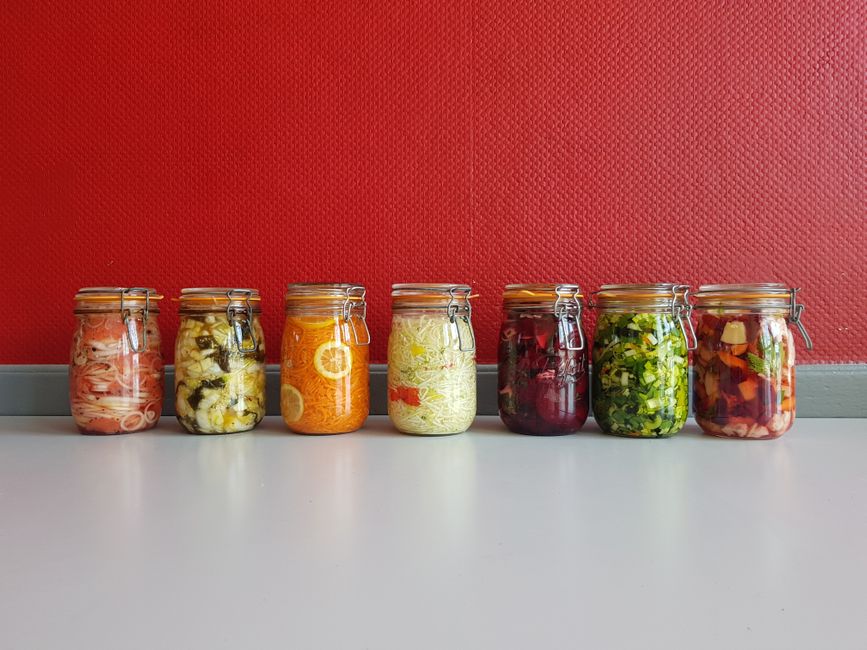
For those who want to venture beyond the dairy aisle, Ruohonjuuri — the organic food chain with its central Helsinki store on Fredrikinkatu in the Punavuori district — stocks a rotating selection of raw sauerkraut, kimchi and water kefir from small Nordic producers. Unlike the pasteurised sauerkraut found in most mainstream supermarkets (which contains no live cultures), raw fermented cabbage retains active bacteria. Prices typically start around €5.90 for a 400-gram jar. The store also carries kombucha from Finnish producer Happy Joe's fermentation line, retailing at approximately €3.50 per 330ml bottle.
Tempeh, a fermented soybean block with firmer texture than tofu and a slightly nutty flavour, has been harder to find locally but is now stocked at the Zero Waste Market on Hämeentie in Kallio, which sources from a small domestic producer in Tampere. At €4.80 for a 300-gram block, it is one of the more cost-effective plant-based fermented proteins available in the city.
How to actually build it into your day
Gut health specialists affiliated with HUS Helsinki University Hospital consistently point to consistency over quantity. Eating a large portion of kimchi once a week delivers less sustained benefit than smaller daily exposure to varied fermented sources. A practical Helsinki approach might look like this: piimä or viili with porridge in the morning, a tablespoon of raw sauerkraut alongside a lunch salad, and the occasional kombucha in place of a soft drink. That pattern can be assembled from products available within two or three stops on the Metro from most parts of the city.
The Hakaniemi and Hietalahti market halls both run summer hours through August, making July a reasonable moment to explore what local producers have on offer. Ruohonjuuri on Fredrikinkatu hosts periodic nutrition talks — the next scheduled session is listed on their website for mid-July 2026. And for anyone uncertain where their own gut microbiome currently stands, the Finnish Institute for Health and Welfare (THL) maintains a public resource page on fermented foods and digestive wellness, updated as of June 2026. Consulting a local GP or registered nutritionist before making significant dietary changes remains the sensible first step, particularly for anyone managing a gastrointestinal condition.